Short answer: Production art, the vector conversion, color separation, embroidery digitizing, and proofing work behind every order, takes real time and a specific skill set that doesn't scale well with a single in-house artist. Promotional product companies, apparel decorators, and print shops outsource it because order volume swings from month to month, because a dedicated team turns files around faster than a generalist juggling other tasks, and because it turns a fixed staffing cost into one that only shows up when there's work to bill it against.
Every order a promotional product company or print shop takes starts with a client's logo and ends with a finished product. In between sits a stack of technical work that clients never see and rarely think about: getting the artwork into a usable format, separating it for the press, digitizing it for the embroidery machine, building a proof for approval. That work is production art, and for a growing number of companies, it's the first thing to get outsourced as volume picks up.
What Production Art Actually Covers
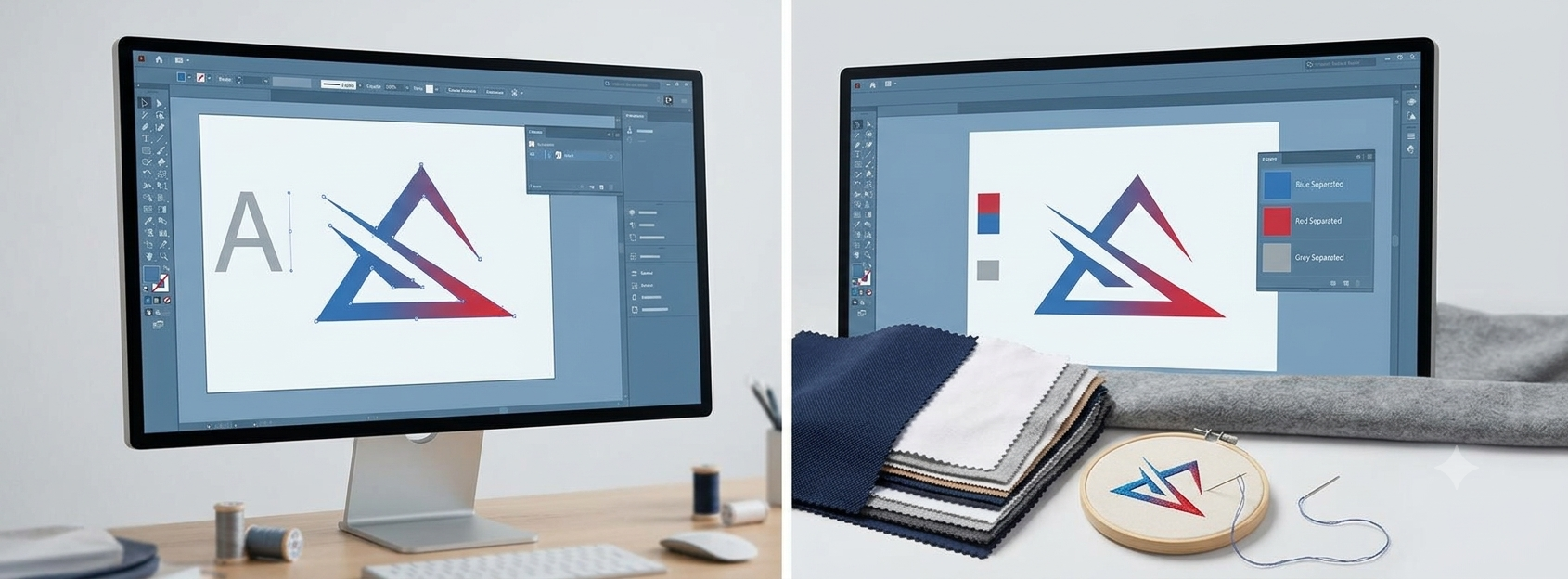
Production art isn't the same as design. Nobody's inventing a new logo here. The job is taking artwork a client already has, usually a JPEG, a PNG, or something pulled off their website, and turning it into a file that production equipment can actually run. That typically includes:
- Vector conversion to rebuild raster logos as clean, scalable artwork (see our guide to vector conversion)
- Color separation to break artwork into the individual ink layers a screen printing press needs
- Embroidery digitizing to turn artwork into a stitch file a machine can run, including specialty techniques like applique and chenille (see our applique vs. chenille guide)
- Virtual proofs and mockups for client approval before anything goes to production (see our guide to virtual proofs)
- Sublimation artwork prep for full-color, all-over print jobs
- Name drops, template placement, and clipping paths for repeat orders and product photography
None of this is optional. A logo doesn't become printable or stitchable on its own, and somebody has to do this work before an order can move forward.
The Problem With Handling It In-House
Volume doesn't stay flat. A promo company might process a handful of logos a week in January and dozens a day heading into back-to-school or year-end gifting season. A single in-house artist, or even two, is either underused in the slow months or completely buried in the busy ones.
It's a specific skill set, not a general one. Clean vector conversion, accurate color separation, and correct embroidery digitizing each take real training. Hiring someone who's genuinely strong across all of it, and keeping them, is harder than it sounds, especially for a company whose core business isn't art production.
One person is a single point of failure. When the one artist who handles digitizing takes a vacation or leaves, orders back up until someone else can pick up the work, or the company scrambles to hire a replacement.
The cost doesn't flex with revenue. A full-time hire costs the same salary, benefits, and software licensing whether the order volume that month is heavy or light. That's a hard cost to justify for a role that exists to support other people's orders.
In-House vs. Outsourced Production Art
| In-house | Outsourced | |
|---|---|---|
| Cost structure | Fixed salary, benefits, and software, regardless of volume | Billed per task or file, scales with actual order volume |
| Capacity during peak season | Limited to however many artists are on staff | Scales up without hiring |
| Skill coverage | Depends on what the hired artist knows well | A team covering vector, separation, digitizing, and proofing |
| Turnaround | Depends on how backed up one person is | Typically 12 to 24 hours, rush options in as little as 4 |
| Risk if someone is out | Work stalls until they're back or replaced | Unaffected, work is handled by a team, not one person |
| Best suited for | Companies with large, steady, predictable volume | Companies with seasonal or variable order volume |
Signs It's Time to Outsource
- Orders are getting held up waiting on art prep, even outside of peak season
- The team is turning down rush jobs because there's no capacity to take them on
- One person's schedule is dictating how fast the whole shop can move
- Quality is inconsistent depending on who happens to be handling a file that week
- The cost of hiring and keeping a specialized artist no longer matches how much of that work actually comes in
None of these have to hit all at once. Even one or two of them is usually enough to make outsourcing the cheaper, faster option.
What to Look for in a Production Art Partner
- Consistent turnaround times that are published up front, not quoted job by job
- Rush options for the orders that can't wait
- Experience across the specific services a company actually needs, whether that's vector conversion, color separation, embroidery digitizing, or all three
- Clear file requirements communicated before an order is sent, not discovered after a rejected file
- A track record with the product types sold, since digitizing for a hat or separating artwork for a tricky fabric isn't the same as a standard polo order
FAQ: Outsourcing Production Art
What counts as production art in the promotional products industry?
Production art covers the technical prep work between a client's logo and a finished product, including vector conversion, color separation, embroidery digitizing, virtual proofs and mockups, sublimation artwork prep, and tasks like name drops, template placement, and clipping paths. It's distinct from creative or brand design, which is about coming up with a logo rather than preparing an existing one for production.
Why do promotional product companies outsource production art instead of hiring in-house?
Production art volume is uneven. A busy season can require far more capacity than a slow month, and a single in-house artist still has to take time off, get sick, or handle a backlog alone. Outsourcing turns a fixed staffing cost into a variable one that scales with order volume.
Is outsourced production art slower than doing it in-house?
Not when working with a dedicated production art team. Standard turnaround is typically 12 to 24 hours, with rush options available in as little as 4 hours, which is often faster than an in-house generalist juggling design, sales support, and other tasks at the same time.
How much does outsourced production art typically cost compared to an in-house hire?
Outsourced production art is usually billed per task or per file, so a company only pays for the work it actually sends out. An in-house hire costs a full salary plus benefits and software regardless of how much work comes in that week.
Vertex Creative Solutions has been handling vector conversion, color separation, embroidery digitizing, and virtual proofs for promotional product companies, apparel decorators, and print shops for over 30 years, across the USA, UK, Canada, and Australia. Typical turnaround is 12 to 24 hours, with rush options in as little as 4.
Explore Our Services arrow_forward